
Urology and andrology (adult, children's)
Group of educational programs: R026Urology and andrology (adult, children's)
Cipher: 7R01128
Duration of study: 3 years, 210 credits
Admission conditions: availability of higher medical education, internship, or a document indicating the qualification of a "doctor" in the program of higher medical education, a doctor's certificate, an entrance exam according to the Admission Policy of students
Tuition fee for 1 year: 2 000 000 tenge
Mission
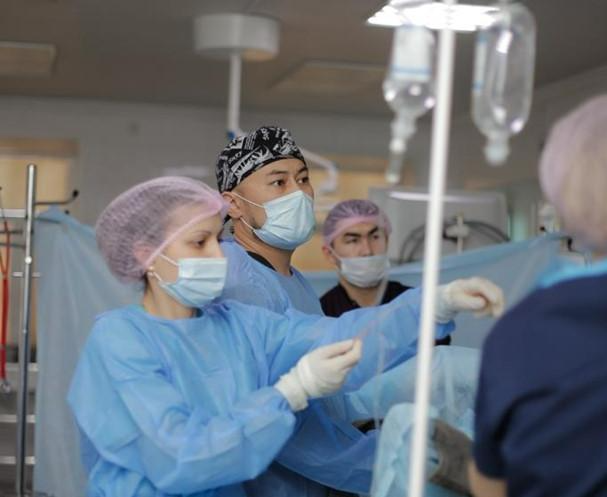
Training a qualified specialist urologist andrologist with a system of general cultural and professional competencies, capable and ready for independent professional activities.
What will you learn?
1st year
- Methods of diagnosis, differential diagnosis of urological diseases at the outpatient level;
- Operative treatment and surgical tactics of patient management in a polyclinic.
2nd year
- Urology at the stationary level;
- Performing operations taking into account the achievements of modern medicine;
- Methods of diagnosis, differential diagnosis;
- Surgical treatment and surgical tactics of patient management in a hospital setting.
3rd year
- Surgical pathology of retroperitoneal space organs in conditions of planned urology;
- Methods of diagnosis, differential diagnosis;
- Surgical treatment using modern minimally invasive and endovideosurgical technologies.
Final learning outcomes
- Demonstrates knowledge in the field of clinical anatomy of the abdominal cavity, pelvis and retroperitoneal space, physiology of hemostasis, as well as the pathogenesis of urological diseases. Maintains medical records in a comprehensive, timely and accurate manner in electronic patient accounting systems.
- Demonstrates knowledge of methods of diagnosis and treatment of acute and chronic urological diseases, to master the tactics of managing patients with suspected emergency conditions in urology in the outpatient and inpatient stages. It is able to recognize and provide medical assistance in case of emergency conditions that threaten the patient's life.
- Demonstrates compassion, integrity and respect for other people. Demonstrates sensitivity and responsiveness to various patients regardless of gender, age, culture, nationality, religion, disability, sexual orientation and other characteristics.
- Performs duties commensurate with their roles, abilities and qualifications, comply with ethical, confidential obligations, requirements of medical ethics and deontology, and use feedback in daily practice. Demonstrates knowledge of conflict management between personal and professional responsibilities, shows flexibility and maturity in adapting to changes, develops the ability to change their behavior.
- Demonstrates commitment to ethical principles related to the provision of patient care, confidentiality, informed consent and business practices, including compliance with relevant laws, policies and regulations. Able to work as a team to create, develop and continuously improve interprofessional groups to provide patient-centered care that is safe, timely, effective and fair.
