
Public health
Degree: Bachelor of Health in the educational program “Public Health”
Group of educational programs: B089 Public health
Cipher: 6B10112
Duration of study: 5 years, 300 credits
Admission conditions: results of a unified national test with a threshold level of 70 points
Major disciplines: biology, chemistry
Tuition fee for 1 year: 1 220 000 tenge
 ext. 1332
 Description of the educational program
To train qualified, competitive public health professionals who meet modern requirements of science and healthcare
Mission
To train qualified, competitive public health professionals who meet modern requirements of science and healthcare
What will you learn?
- In the field of information and communication technologies
- Kazakh (Russian) and English languages
- Emergency care
- On the basics of anatomy, physiology and molecular biology
- In the field of socio-political disciplines, philosophy
- On the basics of basic medical sciences
- On the basics of public health
- As well as understanding the role of microorganisms in human life and in the development of diseases
- On the basics of pathology
Basic knowledge and skills
- Basic Research
- On the basics of disinfection
- On epidemiology
- On the basics of nutrition and municipal hygiene
Basic and professional knowledge and skills
- In the field of information technology in the healthcare sector
- On hygiene of children and adolescents and school medicine
- On quality management of medical services
- On radiation hygiene
Special knowledge and skills
- To promote health and prevent diseases
- Occupational health
- On the epidemiology of especially dangerous infections
- For hygienic disciplines
- Public health
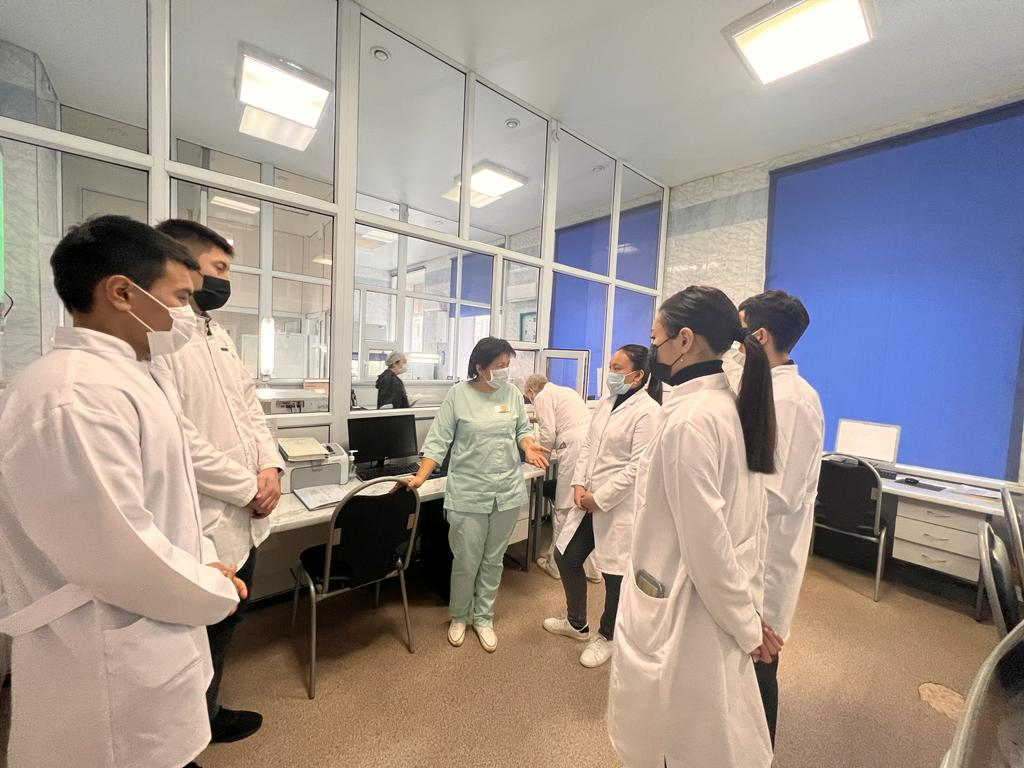
During the training process, you will have professional practice in sanitary and epidemiological control organizations and healthcare organizations
Final learning outcomes
- Builds effective intersectoral interaction with authorities,organizations, the population, community members, the media to effectively address public health problems, including using modern information technologies.
- Possesses the skills of organizing the work of the labor collective, managing human resources, setting goals and formulating tasks, determining priorities for activities.
- Capable of continuous learning and professional development, including the application of artificial intelligence (AI) in healthcare. Able to identify causes, conditions, and risk factors for the spread of infectious, parasitic, and non-infectious diseases, as well as poisonings, using analytical methods and AI technologies. Proficient in various epidemiological research methods, assessing the consequences of diseases and their impact on public health, while utilizing digital technologies and predictive models.
- Knows and uses in practice the regulatory legal acts of the Republic of Kazakhstan on the protection of the health of citizens, sanitary, environmental legislation, the legal framework for the activities of specialists of the state sanitary and epidemiological service.
- Able to maintain accounting and reporting documentation provided for in healthcare organizations.
- Monitors, analyzes and evaluates data on the quality of the environment, health status, the degree of sanitary and epidemiological well-being of the population, as well as performance indicators of healthcare organizations.
- He has the skills to develop, organize and implement sanitary and anti-epidemic and sanitary and preventive measures to promote and protect public health, prevent infectious, parasitic and non-infectious diseases, evaluate their effectiveness.
- Able to investigate, analyze and evaluate the quality indicators of various environmental objects and formulate their own conclusions in the form of recommendations for preventing adverse effects on them.
- ) Able to assess the epidemiological situation, investigate epidemic outbreaks, make an epidemiological diagnosis and issue instructions for disinfection, disinfestation and deratization in foci of infectious diseases, evaluate the effectiveness of immunoprophylaxis among the population.
- Is able to determine the risks of importation of infectious diseases from abroad into the territory of the Republic of Kazakhstan and (or) the occurrence of cases of infectious diseases.
- Able to organize sanitary and epidemiological control of the state of the environment, drinking water, food, supervision of vital objects, protection of borders from the importation and spread of especially dangerous infections in order to develop measures to ensure the sanitary and epidemiological well-being of the population, including in emergency situations.
- Able to carry out epidemiological surveillance and control over the implementation preventive and anti-epidemic measures for infectious and parasitic diseases.
Employment
After completing the educational program, graduates can work in public and private healthcare organizations as:
- Specialist of the Committee of sanitary and epidemiological control and its territorial bodies
- Employee of bacteriological and toxicological laboratories;
- Researcher at research centers and institutes
- Epidemiologist ;
- Microbiologist ;
- Healthcare manager;
- Medical statistician ;
- Methodologist of healthcare organizations ;
- Specialist in social work in the field of healthcare ;
- Teacher at a medical college ;
- Healthy lifestyle specialist
