
IT-medicine
Degree: Bachelor of Natural Sciences in the educational program "IT – medicine"
Group of educational programs: B051 – Biological and Related Sciences
Cipher: 6B05088 (1)
Duration of study: 4 years, 255 credits
Admission conditions: UNT results with a threshold level of 50 points and above
Major disciplines: biology, chemistry
Tuition fee for 1 year: 715 000 tenge


Description of the educational program
Training of specialists for the implementation and maintenance of information technologies aimed at protecting public health, environmental protection and preventive measures
Mission
Training specialists capable of integrating knowledge from natural sciences into the development, implementation and management of IT solutions for healthcare.
What will you learn?
Knowledge and skills:
- In the field of information and communication technologies;
- In the field of mathematics and physics;
- Kazakh (Russian) and English languages;
- On the basics of anatomy, physiology and molecular biology;
- On the basics of programming.
Knowledge and skills:
- In the field of socio-political disciplines, philosophy;
- On human anatomy and physiology, as well as molecular biology;
- On network technologies;
- On epidemiological safety;
- On programming methods and technologies;
- On environmental safety.
Basic knowledge and skills:
- Computer graphics;
- On algorithmization of processes;
- On labor protection;
- According to the methods of scientific research;
- In mathematical statistics, Web programming;
- On the basics of economic activity in the field of medical services.
Basic and professional knowledge and skills
- For the design and development of database applications;
- On biostatistics;
- On e-health;
- Marketing and Communications in healthcare;
- Information security;
- On the basics of management and strategic and operational management.
In the course of training, you will find educational practice, professional practice in healthcare organizations
Final learning outcomes
- Demonstrate knowledge of economics and law, entrepreneurship and financial literacy, natural science disciplines that contribute to the implementation of the main directions of modernization of public consciousness.
- Perform calculations when designing and organizing production processes, relying on knowledge of physical processes, fundamental medical disciplines, as well as principles of preserving the life and health of workers.
- Conduct analysis, planning and management of business activities.
- Manage information technology resources in the healthcare system
- Create and support requirements and technical specifications for the development and modernization of small and medium-scale and complex systems and subsystems for the healthcare system.
- Design conceptual, functional and logical models of a medium to large scale and complexity system for a healthcare system.
- Carry out and manage work on the creation/modification, maintenance of information technologies that automate business processes and organizational management tasks in the healthcare system.
- Carry out network administration and collection, processing, analysis of big data on population health.
- Describe the history, goals, methods, and current issues of major areas of health science using data collection and analysis obtained through information technology
- Using social and behavioral aspects of health in solving health problems using information technologies.
- Apply knowledge of bioengineering and bioinformatics to solve applied problems, implement practical and research skills.
- Regulate the interaction between man and the environment through compliance with the rules of environmental engineering, rational use of natural resources and environmental monitoring..
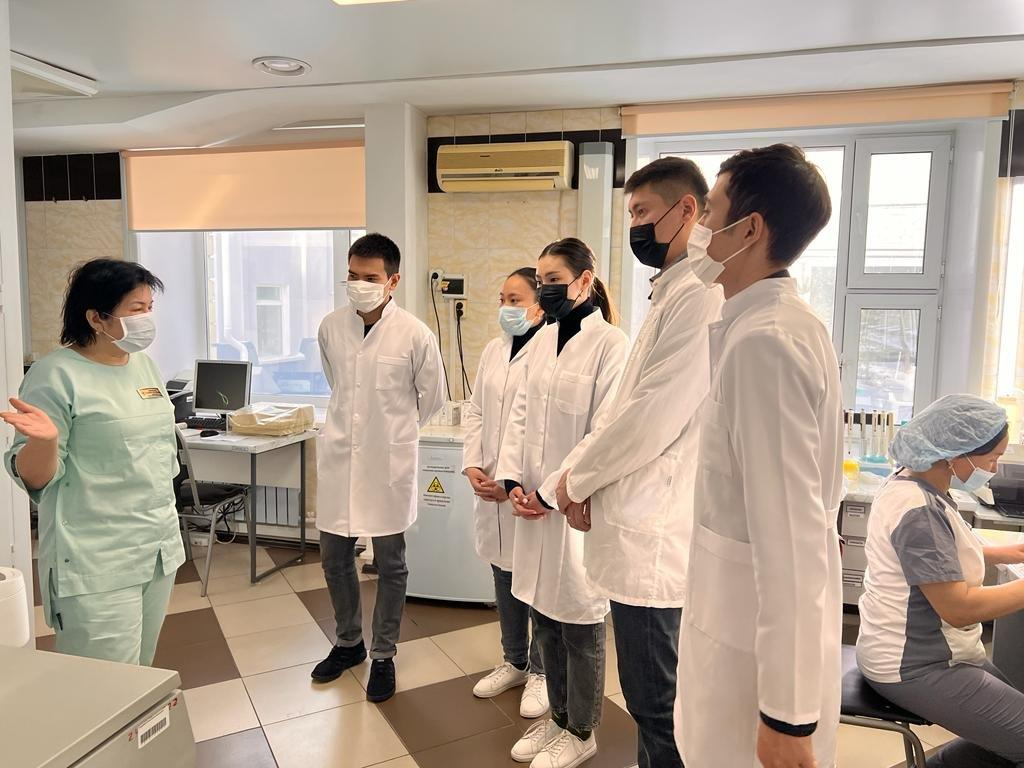
Employment
After completing the educational program, graduates can work in public and private healthcare organizations in:
- Department of Informatization (scientific and technical information);
- Department (laboratories, sectors) for the protection of informatization;
- Chief specialist in the protection of informatization;
- Specialist in ensuring the security of informatization in key infrastructure systems;
- Administrator for information security in key information infrastructure systems.
