
On conducting practical classes at the CSET
To the attention of the teachers of the department / coaches CSET!
There is video surveillance in the Simulation and Educational Technologies Center. In case of non-compliance with the outlined requirements, the administration of the Center has the right to request an explanation and prepare a report to the head of the department or the vice-rector for academic affairs for appropriate measures to be taken.
1. GENERAL PROVISIONS
1.1. The “Schedule for Conducting Practical Classes in the CST” is submitted by the departments one month prior to the start of classes in the CST by filling out the calendar on the portal http://portal.qmu.edu.kz.
1.2. A request for the issuance of educational equipment must be provided electronically via email to the CST trainer's assistant one day before the scheduled class.
1.3. The number of mannequins for the practical class must correspond to the need, calculated at 1 simulator per 3-4 students.
1.4. When planning a practical class in the form of a practical skill demonstration (SRSP) with 2 groups for one instructor, it is necessary to:
Divide the groups by rooms and use video surveillance (one group demonstrating the practical skill while the other group observes the demonstration).
1.5. Create a video recording of the demonstration and use it in classes.
1.6. Utilize electronic textbooks or pre-prepared methodological materials.
1.7. Combining two groups in one classroom is strictly prohibited.
1.8. A maximum of 80% of the time should be dedicated to students mastering practical skills.
Appendix 1 to the Regulations of the Simulation and Educational Technologies Center
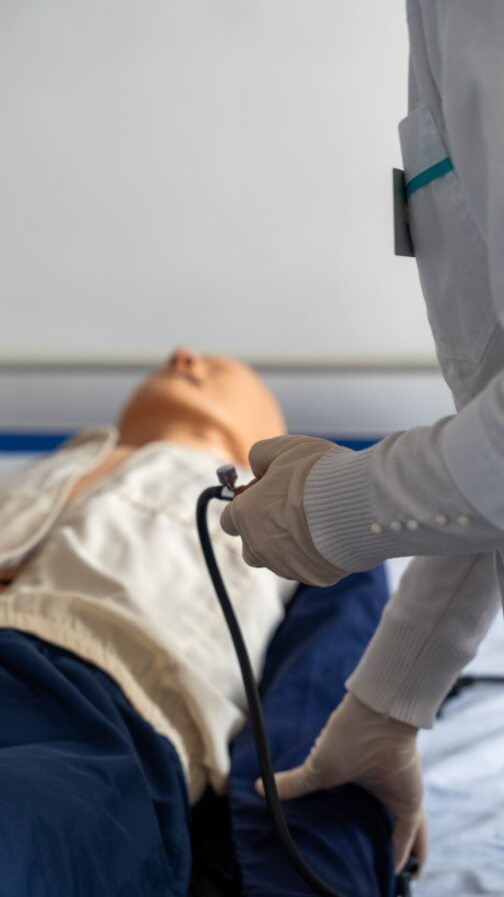
On conducting classes at the
Center for simulation and educational technologies
Simulation technologies in medicine have proven their advantage over the traditional training system. The growing interactivity of the educational environment and the plasticity of interdisciplinary training with an emphasis on self-education dictate the search for promising areas for the development of simulation training.
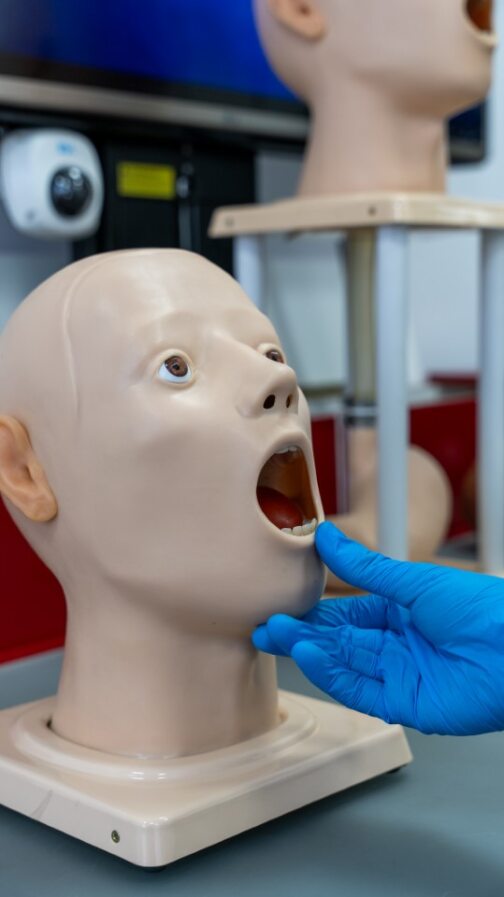
1. GENERAL PROVISIONS
1.1. The schedule for conducting practical classes in the Simulation and Educational Technologies Center (CСOТ) must be submitted by the responsible person for ensuring classes in the ССOТ from the departments at least 1 month before the start of the classes through the portal (http://portal.qmu.edu.kz) – section "Education/Center for Simulation and Educational Technologies." If it is not possible to use the portal, the schedule must be sent in electronic form to the registrar. Within a week of receiving the information from the department, the CСOТ will compare it with the availability of free classrooms and equipment and notify the responsible person from the department of the need to make changes.
1.2. The issuance of educational equipment is carried out by the assistant trainer according to standard requirements, based on the class schedule. If it is necessary to make changes to the standard requirement, the teacher of the department/trainer of the CСOТ must notify the registrar of the CСOТ responsible for compiling the schedule by email at least one day before the scheduled class.
1.3. In the event that it is impossible to meet the requirements (equipment malfunction or unavailability), the registrar must inform the teacher of the department/trainer of the CСOТ at least 3 days before the class about the need to provide a new requirement or adjust the lesson plan.
1.4. The number of manikins for a practical class must correspond to the need, calculated at 1 simulator per 3-4 students.
1.5. When planning to conduct a practical class in the form of SRS, it is necessary to:
- distribute groups by rooms and use video surveillance (one group demonstrates the practical skill while the other observes the demonstration);
- create a video recording of the demonstration and use it in classes;
- use electronic textbooks or pre-prepared methodological materials;
- the merging of two groups in one classroom while performing the skill or clinical scenario is unacceptable.
1.6. When planning a lesson, the maximum amount of time should be devoted to mastering practical skills by students. Upon completion of skill acquisition or clinical scenario execution, a debriefing is conducted with a demonstration of video recordings of students performing the skills, analysis of identified shortcomings, final grading, and determining topics for further independent student work in the CСOТ. During the debriefing, it is permissible to combine two groups of students if the lesson was conducted in the form of SRS.
1.7. Teachers from departments and trainers at the CСOТ must be pre-trained to work on the equipment used in the class and be familiar with the equipment instructions.
2. A memo to the teacher on preparing for class CSET
2.1. The department teacher/trainer of the CSET must arrive at the CSET 15-20 minutes before the start of classes.
2.2. The department teacher/trainer of the CSET must wear a lab coat (with a badge) and changeable shoes.
2.3. During practical classes, the material responsibility for the equipment and medical inventory specified in the requirement is assigned to the department teacher/trainer of the CSET. Before the start of the class, the department teacher/trainer must check the manikins and equipment for functionality.
2.4. The training journal for practical classes in the CSET is issued by the registrar before the start of the class.
2.5. It is necessary to check for the presence of changeable shoes, lab coats, and caps among students. If they are absent, the student is not allowed to attend the class.
2.6. During classes, the department teacher/trainer of the CСOТ must be present in the classroom with the group or monitor the skill acquisition process using the video surveillance system.
2.7. For independent student work, upon prior registration in the registration department, the acquisition of practical skills is conducted according to methodological recommendations developed by the department.
2.8. The group should be released for a break strictly at the scheduled time according to the break schedule in the CSET. Classes must end on time according to the schedule.
2.9. After the end of the classes, it is necessary to check the presence and functionality of the equipment and medical inventory. If any malfunctions are identified, immediately inform the CSET administration.
2.10. The department teacher/trainer of the CSET must hand over the classroom to the assistant trainer, who checks the presence and functionality of the educational equipment and medical inventory. Any malfunction or loss of equipment is recorded in the requirement.
2.11. The department teacher/trainer of the CSET must submit the completed training journal for practical classes to the CSET registrar.
3. Conducting Classes for Acquiring Practical Skills
3.1. The practical class begins with an explanation of the goals and objectives, provision of methodological materials approved by the educational programs committee for the specialty, and an explanation of the skill execution plan to the students.
3.2. The department teacher/trainer of the CSET must assess the level of theoretical preparation of the students for acquiring the practical skill (no more than 15 minutes). A detailed theoretical review of the material should be conducted in the department or during students' independent work according to pre-prepared methodological recommendations. If the lack of theoretical knowledge prevents the student from actively participating in the class, the department teacher/trainer of the CСOТ has the right to consider the student absent from the class, with a requirement to make up for the missed session.
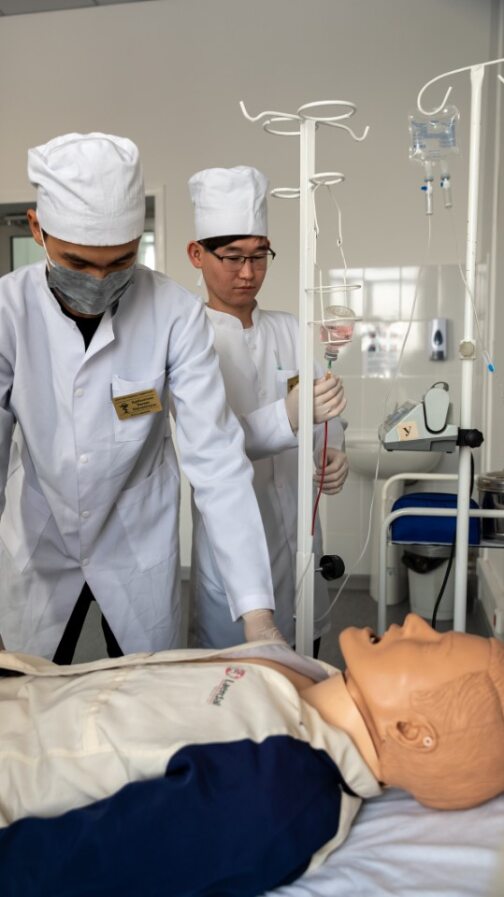
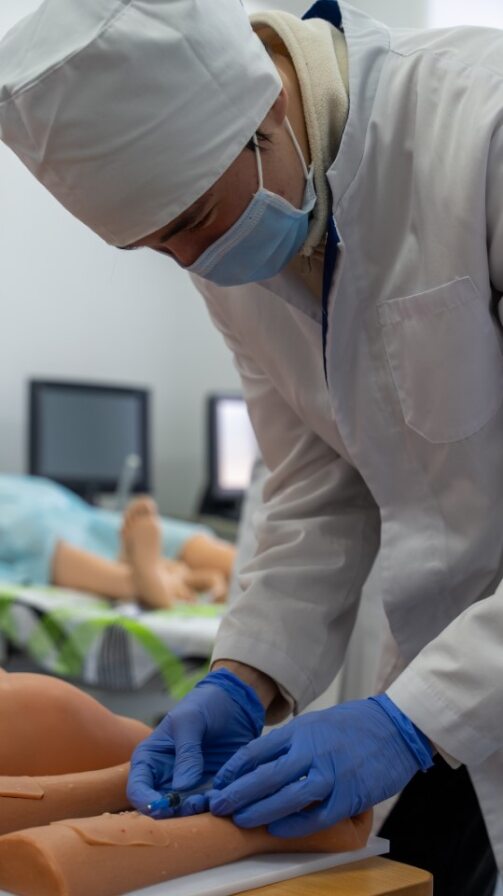
3.3. The department teacher/trainer of the CSET demonstrates the practical skill on manikins using the necessary medical equipment. Video recordings or electronic textbooks may be used. During classes, all students must be actively engaged in the learning process.
3.4. During the class, after demonstrating the manipulation technique, students should begin training on manikins/models under the supervision of the department teacher/trainer of the CSET. The department teacher/trainer controls the groups' work by moving from room to room or using the video surveillance system. If there are not enough training devices, several skills can be rotated (if they are taught in one session).
3.5. When conducting a clinical scenario, the department teacher/trainer of the CSET may divide the group into two subgroups, with one subgroup executing the clinical scenario while the other assesses it, and vice versa. The second subgroup may be in the video surveillance room.
3.6. After completing the clinical scenario, a debriefing is conducted using video recordings of the students' skill execution, during which errors and achievements are discussed. When conducting classes with video recording, the equipment maintenance engineer must be informed in advance.
3.7. Reinforcement of the material is carried out through independent student work by prior registration in the CSET on weekdays after lunch and on Saturday.
3.8. The grade for the performed skill can be assigned during the class or after evaluating the video recordings of the students' independent work.
Note: The procedure for conducting classes may be modified according to the goals and objectives of a specific class.
